Hearing Aids & Accessories
The Difference Between Being Sold a Hearing Aid and Being Fitted With One
I have lost count of the number of people who have come to see me carrying hearing aids they do not wear.
The devices are usually fine. Often they are good devices, from manufacturers I fit myself, bought within the last two or three years. The person paid a lot of money for them, wore them for a few weeks, decided hearing aids were not for them, and put them in a drawer.
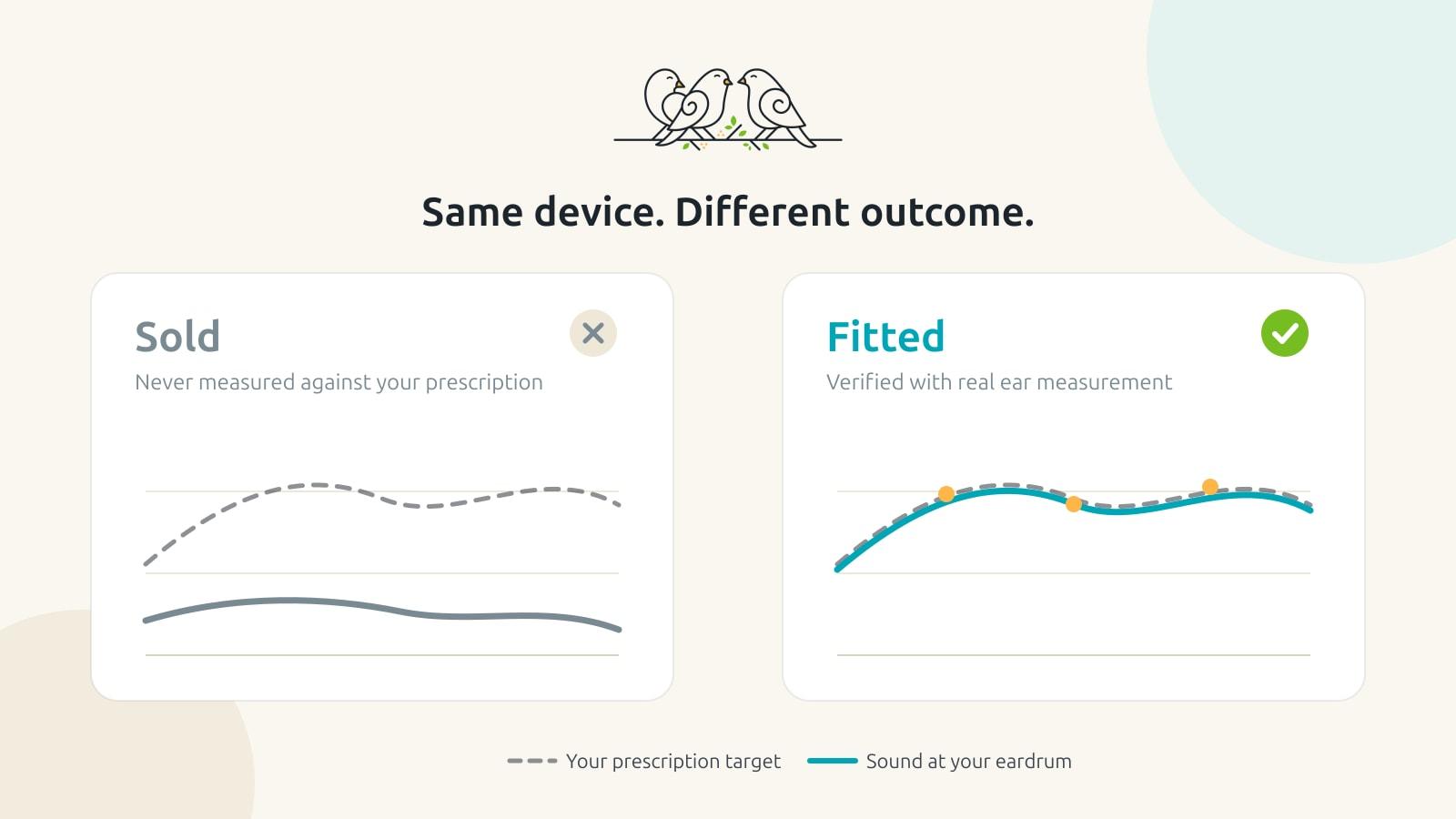
When I measure what those hearing aids are actually delivering into that person’s ear, I frequently find they have never been close to what that person’s hearing loss requires.
The hearing aid was sold. It was never really fitted.
What Fitted Is Supposed to Mean
A hearing aid is a prescription device. Your hearing test produces an audiogram, and the audiogram is run through a validated prescriptive formula. That formula produces a target: how much amplification you need, at which frequencies, at which input levels.
Validated prescriptive formulas exist to give you the best possible hearing across a wide variety of situations. They are not the same thing as the manufacturer’s recommended settings, which are often aimed at acceptance instead. A manufacturer’s first fit may deliberately give you less volume for soft sounds or for sharp sounds, because someone with an acquired hearing loss has not heard those sounds in a long time and may initially find them bothersome. There is a real clinical reason to introduce them gradually, with proper counselling. But if nobody ever closes that gap, you are left permanently missing important information, and sooner or later you will be dissatisfied with how you are hearing, even if you cannot say exactly why.
The target is also specific to you in a more physical way. The amount of amplification that actually reaches your eardrum depends on the shape and size of your ear canal as well as on the settings in the device.
This is the part people are surprised by. Your ear canal is not a neutral tube. It changes sound. Every ear canal is different, so two ears given identical amplification from an identical device will not receive identical sound at the eardrum.
So a hearing aid programmed only through the manufacturer’s fitting software is programmed for an average ear, with settings aimed at acceptance of amplification rather than ideal amplification. Your ear is not an average ear. Without measuring, nobody in the room knows how close to your prescription the device really is.
How We Find Out
We use real ear measurements, sometimes called probe microphone measurements.
A soft, very thin tube goes into your ear canal alongside the hearing aid, close to the eardrum. It carries a tiny microphone. With the hearing aid running, we play calibrated speech and measure what is actually arriving at your eardrum, frequency by frequency, at soft, average and loud inputs.
Then we put that measurement next to your prescription target on the same screen, and we can see exactly where the device is meeting it and where it is not. We adjust, measure again, adjust again, until the two lines match.
Measuring how your ear canal differs from the average ear, and verifying that the hearing aid can truly meet your prescriptive targets, is the most important part of an appointment to deliver new hearing devices. It adds about 20 minutes to the appointment. It is the difference between thinking a hearing aid is right and knowing it.
Why So Many People Have Never Had This Done
Real ear measurement is the gold standard. It is part of every professional fitting protocol, and there is no real debate about whether it should be used.
And yet many clinics that own the equipment do not use it fully. Some run the measurement but never use it to actually adjust the devices. Real ear measurements are almost never done when people are demoing hearing aids, which means people walk out the door with settings nobody has double checked. Most government agencies in Canada require that the measurement be done, but they do not necessarily require that the targets be matched, so a fitting can tick the box without doing the work. The encouraging news is that this kind of verification is done far more commonly in Canada than in the United States. The honest news is that fittings are still often done quickly, and nobody can say with confidence what the outcomes of those quick fittings really look like.
I am not suggesting anyone is acting in bad faith. Some of this comes back to that same tension between acceptance and quality. A fitting aimed at making amplification easy to accept on day one is not the same as a fitting aimed at the best possible hearing, and a fitting done properly takes time and it takes the measurement.
What It Looks Like From the Patient’s Side
Here is the part that matters, because you cannot see any of this happening from the chair.
A hearing aid that has been verified and one that has not can look identical, cost the same, and come from the same manufacturer. The difference shows up weeks later, in whether you can follow your grandchildren at a family dinner, and in whether the devices are on your ears or in a drawer.
If the sound was never right, most people do not conclude that the fitting was inadequate. They conclude that hearing aids do not work for them. That is the outcome I find genuinely frustrating, because it is usually not true, and because the person is often years older before anyone revisits it.
A client came to us recently on the strong recommendation of a friend. She was reasonably satisfied with her existing hearing aids and was honestly unsure about the benefits and value of getting new ones. We reassessed her hearing and fitted new devices, and the measurements told the story: her old hearing aids had never been meeting targets for soft and average speech. She had been compensating on her own, turning the volume up significantly to get through demanding situations and then turning it back down to stay comfortable everywhere else.
Once she was fitted properly with devices verified by real ear measurements, she found she was hearing much better across a variety of listening environments, and she was no longer responsible for constantly adjusting her hearing aids to chase the best sound for each situation. The devices simply amplified sound appropriately, and she could put her attention back on enjoying the people around her.
That is the hidden cost of an incorrectly set hearing aid: extra cognitive load, spent deciding how the hearing aids should be adjusted instead of following the conversation. A properly fit hearing aid should always be working as hard as possible and doing the best job possible at any given moment, so life can be enjoyed rather than managed.
What to Ask, Wherever You Go
You do not need to take my word for any of this, and you do not have to come to us. But if you are getting hearing aids anywhere, ask this question:
“Will you be doing real ear measurements at my fitting?”
The answer tells you a great deal. A clinic that does it will be pleased you asked and will usually offer to show you the screen. If the answer is vague, or the reply is that the manufacturer’s software handles it, you now know something useful about how that fitting will be done.
A few more worth asking:
- Do you fit to a validated prescriptive formula?
- How many follow up appointments are included, and over what period?
- What happens if the settings still are not right after a month?
- Can I see the measurement showing my devices meet target?
None of these are difficult questions for a clinic that does the work.
The Short Version
A hearing aid is not a product you buy, it is a prescription that gets delivered through a device. The device matters much less than most advertising suggests, and the fitting matters much more.
If you have hearing aids that have never sounded right, your first stop should be the clinic that fitted them. Adjustments should be included in the service you already paid for, so ask them to measure your devices against target and show you the result. If that conversation does not go anywhere, it may be a sign that your future hearing care belongs somewhere else.
And when the time comes for your next devices, choose a clinic where the hearing treatment plan includes properly measured, properly fitted hearing aids from the start. That begins with a comprehensive hearing assessment, and it is the standard your hearing deserves.
Explore Our Hearing Care ServicesWas this article helpful?